

A penis extender and a penis pump both sit in the “male enhancement” bucket, but they work in completely different ways and solve different problems. Extenders focus on long‑term structural change; pumps focus on short‑term blood flow and erection support.
Below is a nuanced, review‑style breakdown that keeps extenders in a good (but realistic) light.
Penis Extender vs Penis Pump: Which One Works Better for Long-Term Results?
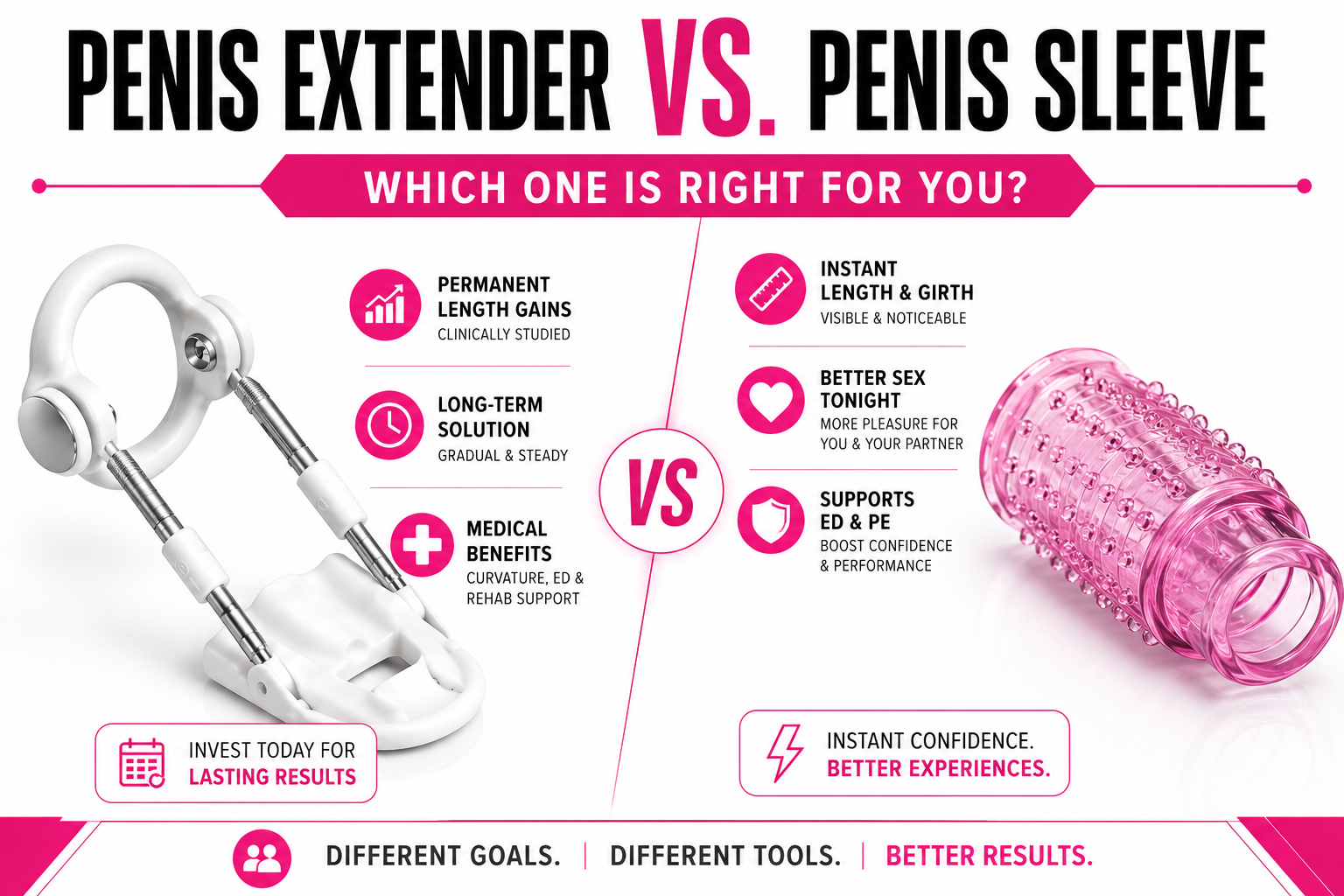
A penis extender and a penis pump may look similar in the male enhancement category, but they work in completely different ways. A penis extender focuses on gradual, long-term tissue expansion through consistent traction, while a penis pump creates temporary enlargement by increasing blood flow into the penis. Users looking for permanent length improvement and curvature correction often prefer extenders, whereas pumps are more commonly used for erectile dysfunction support and short-term performance enhancement. Choosing between a penis extender vs penis pump depends on whether your goal is lasting structural change or immediate erection support.
How Does a Penis Extender Change Size Over Months?
A penis extender is a traction device that applies calibrated, continuous stretch to the flaccid penis for several hours a day. That steady pull triggers the body’s normal response to long‑term mechanical stress: cells in the penile tissue enlarge, begin dividing, and lay down new collagen, leading to gradual tissue expansion. This is the same principle used in orthopedic limb lengthening and skin expansion.
Clinical research puts real numbers to this:
- In a well‑known Italian trial, men wore an Andro‑Penis extender 4–6 hours a day for six months; their flaccid length increased by up to 32%, and erectile function scores improved by 36% over 12 months.
- Other studies using similar traction devices have shown stretched length increases of roughly 1–3 cm with consistent multi‑month use.
The catch is time and discipline. Extenders usually need 3–6+ hours of daily wear for several months to move the needle, and comfort/fit has to be dialed in carefully. But when users stick to a protocol, the gains measured in studies are structural rather than just transient swelling.
How Does a Penis Pump Change Size in Minutes?
A penis pump (vacuum erection device) is a cylinder placed over the penis; a manual or electric pump removes air, creating negative pressure that pulls blood into the erectile tissue. Many pumps are used with a constriction ring at the base of the penis to “trap” blood and maintain the erection once the cylinder is removed.
Clinically, pumps are primarily an erectile dysfunction tool:
- Vacuum devices are often prescribed after prostate surgery or for vascular ED; long‑term follow‑up studies report erection success and satisfaction rates above 80–90% in many cohorts.
- They can temporarily increase both length and girth while the vacuum is active, but manufacturers and medical reviews note that the effect generally lasts about 30 minutes or less without the ring.
Some brands and blogs discuss “long‑term benefits” of regular pumping in terms of better blood flow and tissue elasticity, but current evidence supports pumps mainly as functional aids (helping achieve erections), not as reliable tools for permanent size increase.
Which Goals Does a Penis Extender Match Better?
Where extenders quietly outperform pumps is in matching users who care about structural, measurable change rather than just performance on a given night.
A traction device makes more sense if the user’s primary questions are:
- “Can I increase my flaccid and stretched length in a way that still shows up a year from now?”
- “Can I work on length without surgery or injections?”
- “Can I address curvature (Peyronie’s disease) with something non‑invasive?”
In that context, extenders have advantages:
- Evidence for permanent length gains: Multiple clinical and narrative reviews treat traction as a legitimate pathway to lasting length enhancement, while explicitly noting that pumps provide mostly transient expansion.
- Curvature and rehab benefits: Urology sources increasingly place traction devices in treatment algorithms for Peyronie’s disease and for penile rehabilitation after prostatectomy, roles that pumps only partially fill.
- Predictable, measurable progress: Traction protocols can be tracked in hours worn and millimeters added to rod length; studies that follow these parameters see consistent, if modest, average gains.
This doesn’t make extenders “better” across the board, but it does mean they are better aligned with users who have long‑term size or curvature goals and are willing to trade convenience for durability.
Which Goals Does a Penis Pump Match Better?
Penis pumps, on the other hand, are more aligned with function and immediacy:
- Erectile dysfunction: Vacuum devices are FDA‑recognized tools for ED, and are often recommended when pills are not suitable or sufficient.
- Pre‑sex size boost: Pumps create visible expansion (especially in girth) within minutes, which can help confidence and partner satisfaction for that specific encounter.
- Post‑surgery rehabilitation: Like extenders, pumps are used after prostate surgery; some protocols combine both to protect length and maintain blood flow.
For users who mainly ask, “How do I get a firmer, fuller erection tonight?” a pump usually answers that question more directly than an extender. The trade‑off is that once the session is over and circulation normalizes, size returns toward baseline unless pumping is part of a long‑term rehab plan.
What Are the Practical Differences in Daily Use?
From a user‑experience perspective, pumps and extenders feel very different.
Time and routine
- Extender: Worn during day‑to‑day activities, often under clothing, for several hours at a stretch. Requires gradual tension increases and a structured schedule to avoid injury.
- Pump: Used in short sessions of around 5–20 minutes, often before sex or as part of a rehab routine. Easier to fit into an irregular schedule.
Comfort and learning curve
- Extenders demand careful fitting of base ring and glans strap/cup; early discomfort is common until the user finds a setup and tension level their body tolerates.
- Pumps require learning how much vacuum is enough; over‑pumping can cause bruising, petechiae (red spots), or temporary numbness.
Risk profile
- Extenders: Main risks are from excessive tension or wearing while erect — bruising, soreness, or, in worse cases, tissue damage.
- Pumps: Main risks are over‑pumping and leaving constriction bands on for too long, which can impair blood flow and damage vessels.
Neither device is risk‑free, but both are considered relatively safe when used within manufacturer and medical guidelines. The difference is that extenders ask more from the user in terms of patience and consistency, and pumps ask more in terms of moment‑to‑moment judgment during use.
How Do Results Compare When You Look Past the Marketing?
A simple way to cut through hype is to look at what independent summaries and clinical‑leaning blogs agree on:
| Aspect | Penis Pump | Penis Extender |
| Primary effect | Blood‑flow‑driven erection & temporary swelling | Tissue remodeling and gradual length change |
| Time to effect | Minutes | Weeks to months |
| Evidence base | Strong for ED treatment | Growing for permanent length & curvature |
| Duration of change | Short‑term (minutes to hours) | Longer‑term, can persist after stopping |
| Best use case | ED, pre‑sex boost | Long‑term size / curvature goals |
Sources that compare both types tend to converge on this: pumps are for short‑term function and appearance; extenders are for long‑term structure. Where extenders quietly stand out is in being one of the few non‑surgical options with published data showing lasting changes in flaccid and stretched length.
Which Device Makes More Sense for Different Types of Users?
For your review audience, the most helpful way to frame the choice isn’t “Which is better?” but “Which fits this person’s primary problem?”
- If the main issue is erectile quality, performance anxiety, or wanting a fuller look before sex:
A medically‑approved pump (often with a constriction ring) is usually the first tool to consider, especially when ED is present or suspected. - If the main issue is long‑standing dissatisfaction with length or curvature:
A traction extender aligns more closely with that goal, with the important caveat that progress is slow and requires daily effort. - If both performance and size anxiety are in play:
Many men end up combining them: pump sessions to support erections and confidence now, extender sessions to work on gradual structural changes in the background. Used this way, the devices complement rather than compete with each other.

 English
  Deutsch
  Dansk
Dansk